
Silicon Carbide Material Fabricated using Sintering Additives of Y2O3 and Its Oxidation Characteristics

Abstract
Silicon carbide (SiC) is widely recognized as a promising structural ceramic material owing to its outstanding mechanical and thermal properties, including high strength, hardness, wear resistance, corrosion resistance, and thermal stability. In this study, SiC specimens were fabricated via a liquid-phase sintering technique utilizing Y2O3 and SiO2 as sintering additives. The mechanical performance of the sintered bodies was evaluated through measurements of bulk density and three-point flexural strength. To further investigate the high-temperature oxidation behavior, the mass change and oxide layer thickness of the specimens were examined after thermal exposure. Microstructural and morphological analyses of the oxidized surfaces and cross-sections were conducted using scanning electron microscopy. Additionally, flexural strength tests were performed on oxidized specimens to assess mechanical degradation due to oxidation. The liquid-phase sintered SiC specimens exhibited typical brittle fracture characteristics, with an average flexural strength of approximately 316 MPa in the as-sintered state. Upon oxidation at elevated temperatures, the flexural strength varied depending on the exposure temperature: 189 MPa at 1,200℃, 285 MPa at 1,300℃, and 267 MPa at 1,400℃. The specimen oxidized at 1,300℃ for 10 hours demonstrated the greatest oxide layer thickness and the highest post-oxidation flexural strength.
Keywords:
Silicon Carbide, Sintering Additive, Oxidation Layer, Secondary Phase, Flexural Strength1. Introduction
Silicon carbide (SiC) has garnered significant attention as a candidate structural ceramic due to its exceptional mechanical and thermal properties, including high strength, hardness, wear resistance, corrosion resistance, and thermal stability.1-5) While its room-temperature strength is generally lower than that of silicon nitride (Si3N4), SiC exhibits a notable increase in strength at elevated temperatures exceeding 1,200℃, indicative of superior high-temperature mechanical stability and creep resistance compared to Si3N4. Despite these advantageous properties, the widespread application of SiC has historically been constrained by its inherent difficulty in achieving full densification through conventional sintering processes. The sinterability of SiC is strongly influenced by several factors, including the type and concentration of sintering additives, the presence of impurities, and the particle size of the raw powder. Consequently, the development of optimized sintering strategies has been crucial for enabling its practical use in structural applications. Advances in powder processing and densification technologies have made it possible to fabricate dense, high-performance SiC ceramics. Among these, liquid-phase sintering (LPS) has emerged as an effective method for promoting densification at relatively lower temperatures by introducing oxide additives that form a transient liquid phase during sintering. However, the introduction of such additives also results in the formation of secondary phases, which can significantly affect the high-temperature oxidation behavior of the material. In oxidizing environments at elevated temperatures, silicon carbide undergoes oxidation reactions, the kinetics and mechanisms of which vary depending on the oxidation temperature, duration, and the composition of the secondary phases formed during sintering. Costello et al.6) reported that silica (SiO2) formed on the surface can crystallize into cristobalite, thereby reducing the oxidation rate. In contrast, the presence of alumina (Al2O3) can lead to the formation of aluminosilicates (e.g., Al2SiO5) through a reaction with SiO2, which can accelerate the oxidation process.7) These findings suggest that the oxidation behavior of SiC-based ceramics containing sintering additives can deviate from classical oxidation models, such as Grove’s law, due to the complex chemical interactions between the matrix and the additives. The present study aims to fabricate silicon carbide ceramics via liquid-phase sintering using Y2O3 and SiO2 as sintering additives. The mechanical properties of the sintered specimens were evaluated through density measurements and three-point flexural strength testing. Furthermore, to assess high-temperature oxidation behavior, specimens were subjected to controlled heat treatments, after which weight change and oxidation layer thickness were measured. Microstructural analysis was conducted using scanning electron microscopy (SEM), and post-oxidation mechanical performance was examined via flexural testing to evaluate the relationship between oxidation phenomena and mechanical degradation.
2. Experimental setup and method
In the present study, silicon carbide (SiC) ceramics were fabricated via a liquid-phase sintering (LPS) method, designed to achieve enhanced densification through the incorporation of sintering additives. Commercial β-silicon carbide (β-SiC) powder was employed as the base material, while yttrium oxide (Y2O3) and silicon dioxide (SiO2) were selected as sintering additives to promote the formation of a liquid phase during high-temperature processing. The sintering additives were introduced in a combined amount of 10wt.%, with the Y2O3-to-SiO2 weight ratio fixed at 7:1. This composition was determined based on the Y2O3–SiO2 binary phase diagram, which indicates that the selected ratio facilitates the formation of a liquid phase at approximately 1850°C through chemical interaction between the constituent oxides. The formation of a transient liquid phase at this temperature is anticipated to promote particle rearrangement and densification, thereby reducing the required sintering temperature relative to solid-state sintering approaches. In addition to enhancing densification, the Y2O3-SiO2 system contributes to the formation of a secondary phase. Based on the selected compositional ratio and thermodynamic considerations, yttrium silicate (Y2Si2O7) is expected to form as the primary reaction product of the sintering additives during thermal treatment. The sintering process was carried out under controlled conditions using a hot-pressing technique. As summarized in Table 1, the sintering temperature was set to 1,850℃, with a dwell time of 1 hour under an applied uniaxial pressure of 15 MPa. The entire sintering process was conducted in an inert argon atmosphere to prevent unwanted oxidation and to maintain compositional stability. The silicon carbide sintered body fabricated via the liquid-phase sintering method was initially produced in the form of rectangular plates with approximate dimensions of 40 × 40 × 3.5 mm. Both major surfaces of the sintered body were finished using a precision surface grinder to ensure flatness and uniformity. For mechanical property evaluation, flexural strength specimens were machined in accordance with ASTM C1161 standard specifications, test bars with dimensions of 1.5 mm (thickness) × 2 mm (width) × 25 mm (length). To minimize the influence of surface flaws introduced during machining, all specimens were subsequently subjected to fine surface polishing. To investigate the influence of oxidation temperature and duration on the formation and growth of surface oxide layers, additional specimens were prepared with surfaces polished to a final finish of 1μm using diamond suspension. These specimens were then subjected to isothermal heat treatments in ambient air at three target temperatures: 1,200℃, 1,300℃, and 1,400℃. For each temperature, oxidation durations of 5, 7.5, and 10 hours were employed. Upon completion of each thermal cycle, the specimens were cooled to room temperature in air. Following heat treatment, the oxidized specimens were embedded in epoxy resin and sectioned perpendicular to the surface using a precision linear diamond saw to expose the oxide layer cross-sections. The sectioned surfaces were polished to a mirror finish using diamond abrasives down to 1 μm to enable clear observation. Scanning electron microscopy (SEM) was employed to characterize the microstructural features and to measure the thickness of the oxide layers formed under each set of experimental conditions.

Fabrication condition in hot press for LPS SiC based materials
3. Experimental results and discussion
The cross-sectional micrograph of the Y2O3–SiO2 system shown in Fig. 1(a), localized agglomeration of the sintering additives (indicated by the white regions) was observed, accompanied by a significant number of pores (black regions) in areas where agglomeration did not occur. These microstructural features suggest that densification through liquid-phase formation during sintering was not sufficiently achieved. It is inferred that this heterogeneity arises from the inadequate distribution of the liquid phase among the silicon carbide particle interfaces during the early stages of the sintering process, thereby impeding effective particle rearrangement. A higher magnification image, shown in Fig. 1(b), further highlights the presence of pores within the matrix. These pores, along with the secondary phases present in the microstructure, are known to act as stress concentrators. As a result, they significantly compromise the physical integrity and mechanical performance of the sintered silicon carbide body. The presence of such defects underscores the critical importance of achieving uniform additive dispersion and complete liquid-phase formation to enhance the densification and overall quality of the sintered material. Ceramic materials fabricated through sintering processes inherently contain a certain degree of microporosity due to the incomplete densification that occurs during consolidation. These residual micropores detrimentally affect the physical and mechanical properties of the material and are directly associated with the overall performance and reliability of the final product. Therefore, sintered density is regarded as one of the most fundamental parameters in evaluating the quality of sintered ceramics. Density, defined as mass per unit volume (g/cm³), is commonly determined for porous materials using Archimedes’ principle. The theoretical density of the sintered silicon carbide system was calculated using the rule of mixtures, based on the mass and volume fractions of the primary silicon carbide powder and the sintering additives Y2O3 and SiO2. Relative density was determined by comparing the experimentally measured density, obtained via Archimedes’ method, to the theoretical value. The sintered density was subsequently expressed as a percentage of the theoretical density. For density measurements, twelve specimens were prepared from the liquid-phase sintered silicon carbide batch. The average of these measurements yielded a sintered density of 3.23 g/cm³, while the calculated theoretical density of the Y2O3-SiO2-based system was 3.66 g/cm³. This corresponds to a relative density of approximately 88.2%, which indicates a relatively low densification level under the given sintering conditions (Fig. 2). The mechanical performance of the sintered specimens was assessed through a three-point bending test. The flexural strengths of three representative samples were measured as 308 MPa, 302 MPa, and 338 MPa, resulting in an average flexural strength of approximately 316 MPa. The fracture surfaces, depicted in Fig. 1, revealed characteristic features of brittle failure, which are typical for silicon carbide-based ceramics sintered via the liquid-phase method. A comparative analysis between density and flexural strength data indicated a general trend in which lower sintered density correlated with reduced flexural strength. However, it is important to note that high sintered density does not necessarily guarantee superior mechanical performance. Flexural strength may also be significantly influenced by other factors, including the mechanical characteristics of the secondary phases, the mixing ratios, particle size distribution, and the total content of the sintering additives employed in the fabrication process.8-10) To enable the application of liquid-phase sintered silicon carbide as a structural material in high-temperature oxidizing environments, it is critical to investigate its oxidation behavior and associated characteristics under such conditions. Structural ceramics are generally susceptible to rapid oxidation at elevated temperatures, which can result in significant degradation of their mechanical and physical properties. Accordingly, this study aimed to assess the high-temperature performance of liquid-phase sintered silicon carbide by evaluating its mass change and oxidation response through controlled heat treatment in an air atmosphere. Fig. 3 presents the surface oxidation layers formed on the liquid-phase sintered silicon carbide specimens following oxidation at 1,200℃, 1,300℃, and 1,400℃ for 7.5 hours. A clearly defined oxide layer was observed across the surface of each specimen. Furthermore, within the oxide layer, morphological features such as bubble-like and crater-shaped oxide films were identified, indicating localized gas evolution and non-uniform oxidation processes at certain temperatures. The oxidation behavior of liquid-phase sintered silicon carbide was evaluated by measuring the thickness of the oxide layer formed on specimens oxidized with Y2O3-SiO2 at temperatures of 1,200℃, 1,300℃, and 1,400℃ for durations of 5, 7.5, and 10 hours. Cross-sectional observations were conducted using a scanning electron microscope (SEM), and average oxide layer thickness (OLT) values were obtained for each condition. The Y2O3-SiO2 system exhibited a relatively uniform and flat surface oxide layer. Gas bubbles were observed within the oxidation layer, which are presumed to result from gas evolution reactions occurring at the material surface during high-temperature oxidation. At 1,200℃ and 1,300℃, the oxide layers showed non-uniform morphologies, featuring crater-like formations and entrapped gas bubbles. In contrast, at 1,400℃, a more homogeneous and continuous oxide layer was observed across the entire surface of the material, indicating improved oxidation uniformity at higher temperatures. As illustrated in Fig. 4, the thickness of the oxide layer increased with prolonged oxidation time at all three temperature levels. At 1,200℃, the oxide layer grew from approximately 18.7 μm after 5 hours to 22 μm after 10 hours. At 1,300℃, the thickness increased more significantly, from 26 μm at 5 hours to approximately 74 μm at 10 hours. At 1,400℃, the oxide layer grew from about 30 μm to 42 μm over the same time interval. An anomalous behavior was observed at 1,200℃, where the OLT after 7.5 hours exceeded that measured after 10 hours, suggesting instability in the oxidation kinetics at this temperature. In contrast, the growth rate at 1,300℃ was markedly accelerated between 7.5 and 10 hours, while at 1,400℃, the OLT increased more gradually but consistently over time. These results indicate that the oxidation layer growth rate was highest at 1,300℃, lowest at 1,200℃, and exhibited steady progression at 1,400℃. This results suggest that temperature plays a critical role in oxidation behavior and kinetics, influencing both the morphology and thickness of the resulting oxide layer.
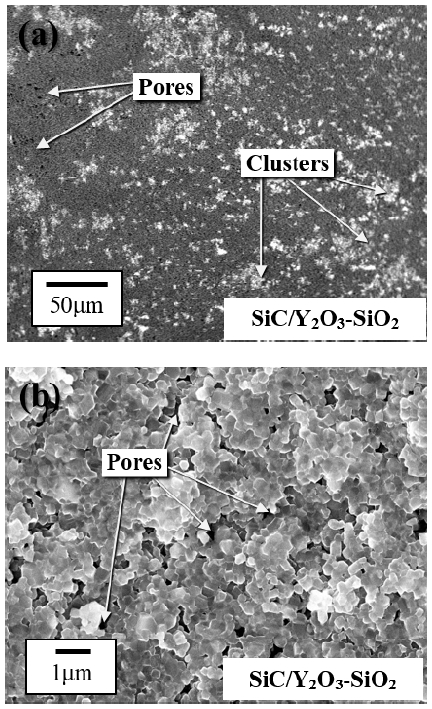
Microstructure of liquid phase sintered silicon carbide materials according to sintering additives
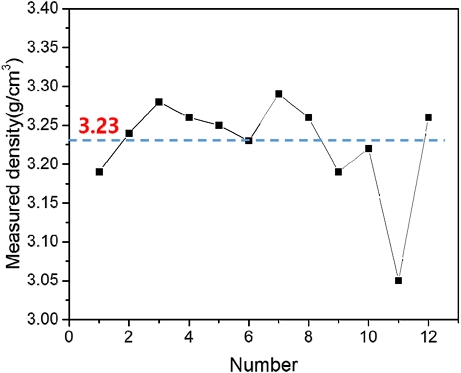
Sintered density of as-received LPS-SiC materials
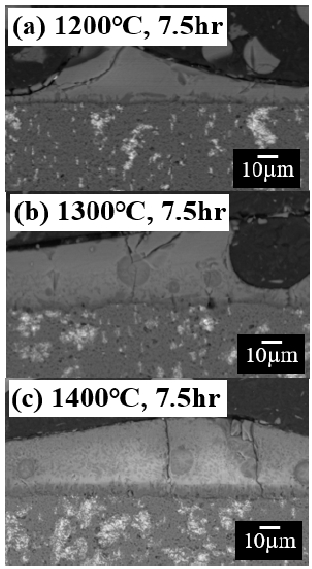
Oxide layer of the LPS-SiC materials with Y2O3-SiO2 system. (a) 1,200℃, (b) 1,300℃, (C) 1,400℃ in air
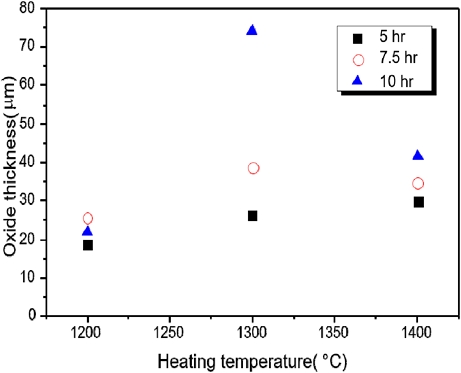
The thickness of the oxide layer according to the oxidation time and heat treatment temperature in Y2O3-SiO2 system
Fig. 5 presents the flexural strength of Y2O3-SiO2 specimens subjected to oxidation at 1,200℃, 1,300℃, and 1,400℃ for a duration of 10 hours. The measured flexural strengths were 189 MPa at 1,200℃, 285 MPa at 1,300℃, and 267 MPa at 1,400℃. As previously shown in Fig. 4, the specimen oxidized at 1,300℃ exhibited the greatest OLT after 10 hours of oxidation. Correspondingly, the highest flexural strength was also observed at this temperature.
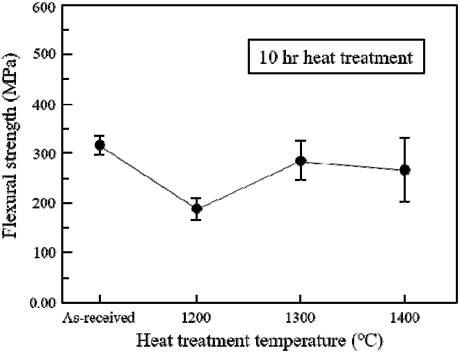
Flexural strength of LPS-SiC material with Y2O3-SiO2 system after heat treatment
These results suggest a partial correlation between OLT and the flexural strength of the oxidized specimens, indicating that oxidation behavior may have a significant influence on the mechanical performance of liquid-phase sintered silicon carbide.
4. Conclusions
In this study, silicon carbide was fabricated using a liquid-phase sintering method with Y2O3-SiO2 as the sintering additive, and its oxidation behavior and mechanical properties were systematically evaluated. The main findings are summarized as follows:
1) The theoretical density of the Y2O3-SiO2 system was calculated to be 3.66 g/cm³. The average sintered density, as measured by the Archimedes method, was 3.23 g/cm³, corresponding to a relative density of approximately 88.2%. This indicates a relatively low level of densification compared to the theoretical maximum.
2) The liquid-phase sintered silicon carbide exhibited typical brittle fracture characteristics, as confirmed by fracture surface analysis, and demonstrated an average flexural strength of approximately 316 MPa.
3) Oxidation behavior varied with temperature. At 1,200℃ and 1,300℃, the oxidation layers were non-uniform, displaying crater-like features and entrapped gas bubbles. In contrast, at 1,400℃, the oxide layer was more uniform and continuous across the entire surface of the specimen.
4) The flexural strengths of oxidized specimens were 189 MPa at 1,200℃, 285 MPa at 1,300℃, and 267 MPa at 1,400℃. The specimen oxidized at 1,300℃ for 10 hours exhibited both the thickest oxidation layer and the highest flexural strength, suggesting a potential correlation between oxide layer growth and mechanical reinforcement under certain conditions.
Acknowledgments
This research is part of Jae-Hwan Kwak master’s thesis.
Author contributions
S. P. Lee; Conceptualization. J. H. Kwak; Data curation, Investigation. J. K. Lee; Writing-review & editing.
References
-
T. Zhong, L. Lei, Z. Zhang, D. Hu and J. Zhang, 2024, “Preparation of High-Strength Silicon Carbide by SLS-RS”, Materials Science and Engineering : A, 914, 147114.
[https://doi.org/10.1016/j.msea.2024.147114]

-
T. N. Abebe, H. G. Kim, B. H. Woo and J. S. Ryou, 2024, “Assessment of Impact Load Effect on Self-Sensing of Cement Composites Incorporating Hybrid Silicon Carbide-Graphite under Various Environmental Conditions”, Construction and Building Materials, 451, 138755.
[https://doi.org/10.1016/j.conbuildmat.2024.138755]
-
X. Chen, L. Ge, K. Y. Cheong, J. Han, H. P. Phan and M. Xu, 2025, “Performance Improvement of Silicon Carbide Gate Oxide Interface by Pre-Oxidation”, Applied Surface Science, 688, 162359.
[https://doi.org/10.1016/j.apsusc.2025.162359]
-
Y. Gu, Z. Guo, F. Lu, J. Lin, X. Chen, X. Xu, Z. Xu and H. Zhao, 2023, “Research on the Method of the UV Photocatalytic-Roll- Vibrated Composite Polishing for Silicon Carbide Ceramic”, Optics & Laser Technology, 167, 109718.
[https://doi.org/10.1016/j.optlastec.2023.109718]
-
A. Y. Pak, K. B. Larionov, A. P. Korchagina, T. Y. Yakich, A. Y. Nalivaiko, A. A. Gromov, 2021, “Silicon Carbide Obtaining with DC Arc-Discharge Plasma: Synthesis, Product Characterization and Purification”, Materials Chemistry and Physics, 271, 124938.
[https://doi.org/10.1016/j.matchemphys.2021.124938]
-
J. A. Costello and R. E. Tressler, 1985, “Oxygen Penetration into Silicon Carbide Ceramics during Oxidation”, Ceramics International, 11(2), 39-44.
[https://doi.org/10.1016/0272-8842(85)90007-0]
-
S. C. Singhal and F. F. Lange, 1975, “Effect of Alumina Content on the Oxidation of Hot-Pressed Silicon Carbide”, Journal of the American Ceramic Society, 58(9-10), 433-435.
[https://doi.org/10.1111/j.1151-2916.1975.tb19016.x]
- R. M. German, 1996, Sintering Theory and Practice, Wiley.inf.
-
K. W. Kim, W. S. Kim and J. B. Lee, 2020, “An Experimental Study on the Development of similarity Method for the Pressure Drop of Moisture Separator”, Journal of Power System Engineering, 24(6), 82-91.
[https://doi.org/10.9726/kspse.2020.24.6.082]
-
D. K. Kang and J. H. Park, 2021, “Mechanical Properties of V Scart Joint Repair surface of FRP Vessels through Hybrid Fiber Lamination”, Journal of Power System Engineering, 25(4), 23-31.
[https://doi.org/10.9726/kspse.2021.25.4.023]