
A Strategic Study on the Establishment of Quality Inspection for Shipbuilding Equipment Using 3D Vision Inspection Technology

Abstract
This study presents the development of a 3D vision–based quality inspection platform applied to Printed Circuit Heat Exchangers (PCHE) and Shell & Plate heat exchangers (SPHE), which are among the core components of LNG carrier systems. The proposed system aims to overcome the limitations of conventional manual inspection methods and to establish a standardized inspection framework compliant with international quality standards. The inspection performance and economic feasibility were analyzed through a comparative evaluation before and after system implementation. As a result, the average inspection time was reduced by more than 60%, and the time required for report generation decreased by 95%. The defect detection rate improved from 79.2% to 96.4%, and the rework rate decreased from 6.1% to 1.3%. Economic analysis confirmed an annual cost reduction of approximately KRW 44 million, with an ROI of 32.5% and a BEP of 3.06 years. Furthermore, the system demonstrated conformity with international standards including ISO 19087, ISO 9001, and classification society regulations (KR, ABS, DNV, LR). This study not only verified the applicability of 3D vision inspection in the shipbuilding equipment manufacturing process but also provided an empirical foundation for smart factory transformation and 3D-based quality management in small and medium-sized shipbuilding industry.
Keywords:
3D Vision Inspection, Shipbuilding Equipment, Heat Exchanger, Smart Factory, International Standards1. 서 론
The 80th session of the Marine Environment Protection Committee (MEPC 80) of the International Maritime Organization (IMO) confirmed a strengthened greenhouse gas (GHG) reduction strategy, accelerating the transition toward low- and zero-carbon fuels in the maritime sector.1) Consequently, the global shipbuilding industry is increasingly required to adopt eco-friendly energy systems and to ensure the stable and reliable operation of equipment under high-temperature and high-pressure conditions.2,3) In this context, the establishment of intelligent quality management and smart production systems has become a critical factor for competitiveness in the shipbuilding equipment manufacturing sector.4)
Among various components, the heat exchanger is a vital device that performs essential roles in fuel supply, cooling, vaporization, and condensation processes.5) Its manufacturing demands high dimensional precision, and therefore, a robust and systematic quality inspection framework is indispensable.6) However, conventional inspection methods relying on human experience, visual observation, and manual measurement tools lack objectivity and reproducibility, often resulting in inconsistent quality assurance.
To overcome these limitations, automated inspection technologies leveraging information and communication technology (ICT) have been actively studied. In particular, 3D vision–based quality inspection platforms enable precise measurement of components with complex geometries and facilitate automated data comparison, deviation analysis, and real-time data management.4-7). These capabilities have the potential to transform the conventional inspection paradigm within the shipbuilding equipment industry.
Nevertheless, the shipbuilding equipment industry is characterized by high-mix, low-volume production and the frequent handling of large, curved, and high-precision parts, making inspection automation challenging compared to other manufacturing sectors. Specifically, Printed Circuit Heat Exchangers(PCHE) and Shell & Plate Heat Exchanger(SPHE) which are key components in eco-friendly fuel systems pose additional challenges in detecting dimensional deviations, surface irregularities, welding volume inconsistencies, and bonding defects due to their diffusion-bonded structures and intricate internal geometries.8)
Moreover, with the growing emphasis on ESG (Environmental, Social, and Governance) management and national smart factory promotion policies, the acquisition and quantitative analysis of real-time quality data have become indispensable.9,10) These are not only essential for meeting customer and classification society requirements but also for lifecycle quality traceability and certification compliance. However, many small and medium-sized shipbuilding equipment manufacturers in Korea remain hesitant to adopt such systems due to limited technical awareness, difficulties in ROI evaluation, and the absence of standardized integration frameworks.
Accordingly, this study applies 3D vision recognition technology to PCHE and SPHE heat exchangers to evaluate its advantages over traditional inspection methods. Furthermore, it proposes a standardized inspection model that can be integrated with industrial and international certification systems to enhance quality assurance in the shipbuilding equipment sector.
2. Theoretical Background and Key Research
2.1 Overview of Heat Exchangers for Ships
In the shipbuilding and marine industries, most heat exchanger development efforts have focused on ultra-low-temperature applications, particularly for core systems such as Liquefied Natural Gas (LNG) vaporization and Boil-off Gas (BOG) re-condensation systems.5-8)
Due to spatial constraints on ships and offshore platforms, conventional large heat exchangers are gradually being replaced by compact types. In particular, high-efficiency compact exchangers designed for LNG vaporization and liquefaction processes are being actively developed.
Among various types, the Shell & Plate Heat Exchanger (SPHE) and the Printed Circuit Heat Exchanger (PCHE) are the most notable. The SPHE combines the advantages of both plate and shell-and-tube designs, offering high heat-transfer efficiency per unit volume through an expanded heat-transfer surface area. It also features a compact structure with simplified maintenance requirements. The PCHE, on the other hand, utilizes a diffusion-bonding process to join stacked heat-transfer plates, resulting in an exceptionally compact configuration suitable for multi-fluid operation. This structure enables the integration of multiple heat-exchange units into a single body, thereby reducing overall installation space and manufacturing cost.
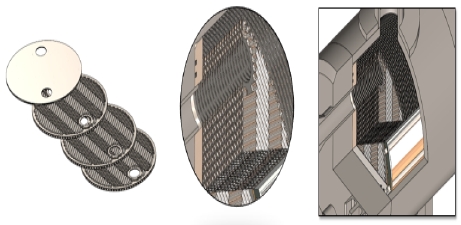
As these products continue to evolve toward higher technological sophistication and miniaturization, the existing quality management systems of small and medium-sized enterprises (SMEs) are often inadequate to meet the precision and reliability requirements of such advanced designs. Fig. 1 shows a 3D model of the SPHE referenced in this section.
SPHE (Shell & Plate Heat Exchanger)
2.2 Quality Inspection Process and 3D Vision Technical Overview
The quality inspection process in the shipbuilding and marine equipment industry generally consists of several stages, including material receiving inspection, dimensional and welding inspection, Non-Destructive Testing (NDT), pressure testing, visual inspection, and final shipment inspection. In particular, dimensional and visual inspections of heat exchangers are critical steps to ensure compliance with design drawings, customer specifications, and international standards. These inspections require precise and quantitative evaluation of dimensional accuracy, weld deformation, and surface irregularities. However, traditional hand-tool–based methods have clear limitations in repeatability, accuracy, and data traceability.
Three-dimensional (3D) object recognition technologies used for industrial inspection can generally be classified into hardware-based and software-based approaches. Hardware-based systems typically include RGB-D cameras, stereo vision cameras, and laser scanners. These devices acquire spatial information of an object to extract parameters such as shape, size, position, and geometric tolerances. Such methods offer high measurement precision and strong adaptability to environmental conditions.
In contrast, software-based approaches rely on computer vision and deep learning models for feature extraction, defect recognition, and dimensional analysis. Modern architectures such as YOLO (You Only Look Once) and Mask R-CNN demonstrate high accuracy and real-time performance in defect detection tasks. In 3D object recognition, emerging techniques such as Monocular Depth Estimation and OpenStereo are gaining attention for their ability to infer geometric depth from two-dimensional data. When integrated with anomaly detection algorithms, these models form the basis of advanced 3D vision inspection systems.
2.3 Quality and Economic Evaluation in Existing Research
Academic research on smart factory implementation within the shipbuilding industry has been steadily accumulating. One study, which considered the unique characteristics of the shipbuilding sector, proposed a smart factory model based on Product Lifecycle Management (PLM). The research demonstrated that PLM-based smart factories enhance process control and overall product quality by efficiently managing complex production workflows4). Quantitative analyses of smart factory adoption have also been conducted into financial performance and non-financial performance7).
In terms of quality monitoring, several studies have explored AI-based inspection and monitoring technologies. A study on real-time defect detection in optical product manufacturing demonstrated that AI vision systems can identify fine defects with higher precision and efficiency than conventional 2D image-processing methods11). Similarly, research on a cyber-physical production system incorporating a vision-based worker assistance platform for manual assembly lines in an Italian auto parts manufacturer (Intractable SRL) verified its practical effectiveness in improving operational reliability14).
There has also been extensive research on 3D vision technology. For example, one study systematically classified surface defect detection techniques using 3D point cloud data, while another proposed an intelligent vision-based quality inspection system that integrates 3D Structured Light Scanning (SLS) with data-mining algorithms such as Decision Tree, Artificial Neural Network (ANN), and Support Vector Machine (SVM)16) . In addition, to overcome the limitations of traditional line-laser–based 3D scanning systems in large-scale shipbuilding assembly, researchers have designed a large-environment 3D inspection system utilizing industrial cameras and multi-sensor point-cloud matching algorithms17). In the aerospace sector, studies have emphasized the substitution of manual mechanical inspection with machine vision technologies to achieve higher precision and stability18). Furthermore, a deep-learning–based 3D vision inspection system was proposed for defect detection and quality control in robot-assisted adhesive dispensing for large aluminum profiles19). Another study suggested an integrated framework combining deep learning and statistical quality control for enhanced manufacturing quality assurance20).
2.4 Review of International and Domestic Standards
The ISO 19087 standard provides a framework for 3D measurement and vision-based inspection using optical metrology under the domain of nanotechnologies. It specifies requirements for measurement accuracy, calibration, and data-matching methodologies. In this study, the design principles, inspection protocols, and traceability requirements defined in ISO 19087 are referenced to establish the analytical indicators and system specifications for the proposed inspection platform.
Major classification societies, including the Korean Register (KR) and the American Bureau of Shipping (ABS), define detailed requirements for drawing conformity, dimensional tolerance, weld quality, and pressure testing in the design, manufacturing, and inspection stages of heat exchangers. Furthermore, these standards specify calibration and precision criteria for inspection tools. In this study, these criteria were quantitatively reflected in the establishment of vision-based inspection parameters and acceptance criteria, which were subsequently applied to empirical validation.
3. Evaluation Framework
3.1 Conceptual Diagram and Evaluation Flow
This study aims to enhance the quality inspection process in the manufacturing of shipbuilding equipment, with a particular focus on evaluating the effectiveness of 3D vision-based automated inspection technology and proposing strategies for its standardization and integration. The overall research flow consists of four major phases.
Phase 1: Establish the foundational investigation and reference standards by analyzing product characteristics, existing inspection processes, and applicable quality requirements. Based on this analysis, define the objectives and criteria for the introduction of 3D vision technology.
Phase 2: Design the 3D vision inspection and evaluation model, including system configuration, definition of inspection parameters, and formulation of analytical indicators.
Phase 3: Conduct empirical validation by implementing the proposed system at the Donghwa Entec manufacturing site and performing a quantitative comparison with traditional inspection methods.
Phase 4: Evaluate alignment with domestic and international standards, including ISO, classification society, and customer requirements. Derive strategies for practical application and review the potential for future scalability and standard linkage.
3.2 Key Analytical Indicators
To quantitatively evaluate the effectiveness of introducing the 3D vision–based inspection system, an analytical framework was developed as summarized in Table 1. The indicators were categorized into four perspectives: quality performance, process efficiency, economic feasibility, and standard compliance.

Analytical Framework
From the quality performance perspective, the primary indicators include inspection accuracy and defect detection rate, which were compared with those of conventional inspection methods to assess improvements in detection precision and reliability.
From the process efficiency perspective, inspection time, required manpower, and rework rate were selected as major indicators to evaluate reductions in time and labor cost resulting from automation.
From the economic feasibility perspective, investment cost, annual cost savings, return on investment (ROI), and net present value (NPV) were set as indicators to assess the financial viability and payback potential of system implementation.
Finally, from the standard compliance perspective, the number of items corresponding to the requirements of ISO 9001, ISO 19087, and classification society standards (e.g., KR, ABS) was established as an indicator to evaluate certification consistency and linkage potential.
3.3 Application Process and Introduction of 3D Vision Technology
The scope of this study encompasses the inspection processes of PCHE and SPHE, which are representative heat exchanger systems in the shipbuilding industry. The primary inspection targets include weld surface appearance and geometry, dimensional accuracy after machining, overall shape verification following assembly, and conformity of curved geometries and geometric tolerances.
For the PCHE, conventional inspection of diffusion-bonding surfaces and inlet/outlet port alignment has typically relied on calipers and mechanical gauges. In this study, a 3D vision scanning system is introduced to verify dimensional conformity and drawing consistency.
For the SPHE, the 3D scanner is applied to assess plate alignment deviations and housing assembly surface errors that are difficult to measure accurately using manual tools. Table 2 summarizes the specific inspection items and application areas for each heat exchanger type.
Product-specific Inspection Items
The 3D vision-based inspection system applied in this study consists of a portable 3D scanner (KEYENCE WM-6225). The handheld device provides a measurement accuracy of up to ±20 μm and enables non-contact dimensional inspection of large and complex components. The accompanying software allows registration of reference points and facilitates direct comparison between measured data and design drawings, with built-in functionality to automatically determine whether the results fall within specified tolerances. In addition, the system supports automatic integration with the existing Enterprise Resource Planning (ERP) system through product codes and is linked to the Manufacturing Execution System (MES) to automatically load inspection items and parameters. Upon completion of measurement, the software automatically generates inspection reports and visualizes defect locations, allowing inspectors to intuitively verify deviations and quality anomalies.
3.4 Analysis Methods and Application Strategies
The objectives of this study are threefold: to identify changes in quality indicators through improvements in inspection performance, to verify the linkage of the proposed inspection system with international standards and certifications, and to assess its economic feasibility.
To achieve these goals, a quantitative comparison was performed between the existing manual inspection method and the 3D vision–based automated inspection system. Key indicators such as inspection accuracy, required time, and defect detection rate were analyzed to evaluate performance improvements and confirm the practical effectiveness of the proposed approach.
For the economic analysis, both investment cost and cost reduction effects were examined. Initial investment factors included equipment cost, operator training time, and maintenance expenses, while cost-saving factors comprised reductions in labor, rework, and quality-related costs. Based on these data, financial metrics such as Return on Investment (ROI) and Break-Even Point (BEP) were calculated to evaluate investment efficiency and profitability.
ROI is a key financial metric that measures the ratio of net income to total investment and is used to assess investment efficiency, project prioritization, and profitability. It is defined as equation (1) below
| (1) |
BEP represents the break-even point at which total revenue equals total cost, indicating the threshold beyond which profit begins to accumulate. It is expressed as equation (2) below.
| (2) |
Finally, to ensure proper operation and certification readiness of the 3D vision system, compliance strategies were established in alignment with relevant international and domestic standards. the core measurement principles referenced in ISO 19087 (e.g., accuracy, repeatability, calibration transparency, and traceability) were used as design guidelines for measurement reliability, rather than applying the standard directly. ISO 9001 principles were applied to manage inspection history within the quality management framework and to validate inspection records. In addition, conformity with classification society criteria and advanced inspection standards was reviewed to ensure comprehensive applicability.
4. Case Study and Empirical Evaluation
4.1 Scenario Overview and Application
The empirical evaluation was conducted over a six-month period (April–September 2025) on standardized PCHE and SPHE prototype units. A total of 40 sets were evaluated for each product type. Measurements were performed by trained inspectors following a consistent procedure, and repeated measurements were conducted for selected items to check measurement consistency. The KEYENCE WM-6225 3D coordinate measurement system was introduced to address the limitations of conventional hand-tool-based inspection and to obtain quantitative, objective quality data.
The experiment was carried out in a general non-cleanroom laboratory environment. The illuminance during measurement was maintained between 500 and 600 lux, corresponding to the standard lighting condition for single-operator inspection tasks. Measurements were performed through direct comparison with CAD reference drawings to ensure geometric conformity and dimensional accuracy. A summary of the application environment and measurement setup is presented in Table 3.
Application Target and Environment
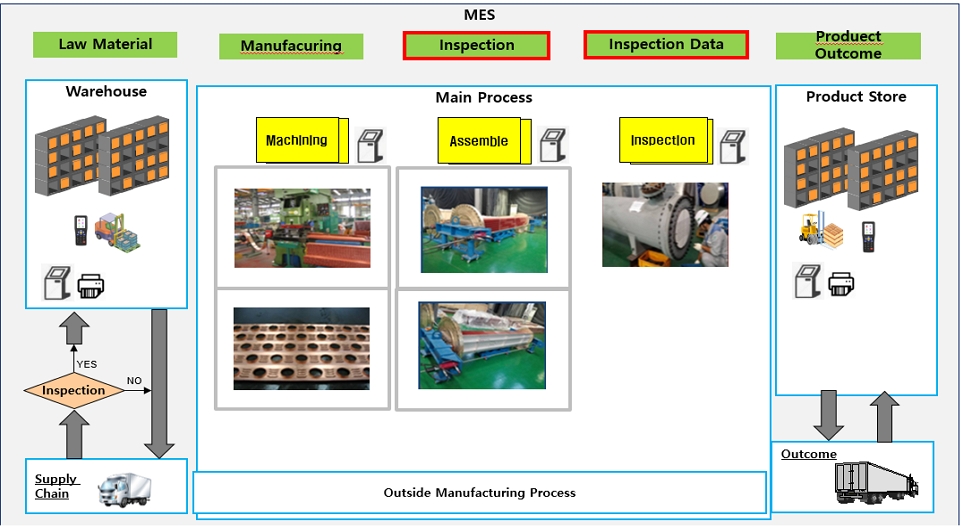
In the conventional inspection process, the final inspection schedule is registered in the Manufacturing Execution System (MES). Once an inspection request is initiated, the inspector conducts the final product inspection according to the requirements specified in the MES. Inspection results are manually entered into the MES, and the inspection report is subsequently uploaded by hand. This manual procedure represents the typical work method used by shipbuilding equipment manufacturers. However, it has several limitations, including delayed feedback across the inspection workflow and insufficient reliability of inspection results due to human dependency.
As illustrated in Fig. 2, the traditional inspection flow begins with the receipt of heat exchanger plate materials at the warehouse, followed by the assembly of the shell and cover components, and concludes with final inspection using hand tools. This process, while standard in conventional shipbuilding equipment manufacturing, lacks automation and quantitative verification capability.
Conventional Inspection Process Flow
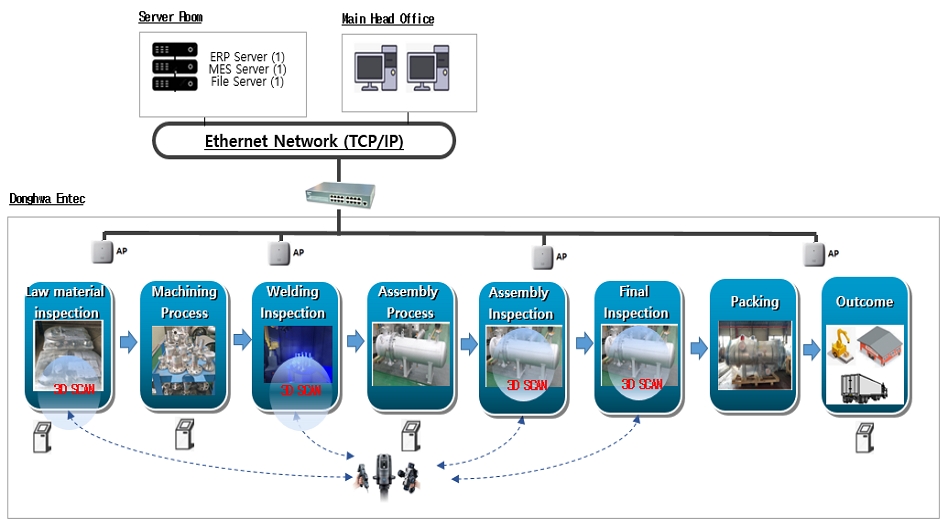
The 3D vision–based inspection process follows the same overall sequence as the conventional inspection workflow but incorporates digital automation and data integration at each stage. Each material and process step - ranging from receiving and machining to assembly and final inspection - is tracked through a QR code registered in the Manufacturing Execution System (MES). The basic process data associated with each QR code are automatically transmitted to the 3D vision inspection system. At each step, the inspector performs non-contact measurement of components or assemblies using the 3D scanner. The acquired scan data are automatically compared with the corresponding CAD reference model, and deviations are evaluated based on predefined tolerance criteria. The inspection results are analyzed and automatically classified as “pass” or “fail.” All measured data are transmitted in real time to the MES via a daemon server, enabling continuous synchronization between the vision system and the production database. The system also generates inspection reports automatically and archives them within the MES to maintain traceability.
Furthermore, inspection results are stored in the ERP server, allowing production and quality managers to monitor process status and inspection outcomes in real time, and to authorize subsequent manufacturing steps. The overall 3D vision inspection workflow is illustrated in Fig. 3.
3D Vision Inspection Process Flow
4.2 Comparison of Quality and Process Performance manual and 3D Equipment Adoption
A comparative evaluation of inspection performance before and after the adoption of the KEYENCE WM-6225 3D vision inspection system revealed substantial improvements in inspection efficiency and accuracy. The average inspection time was reduced from approximately 25–30 minutes to 10–12 minutes, representing a reduction of more than 60%. Additionally, the time required to generate inspection reports decreased by over 95%, from an average of 20 minutes to approximately 1 minute, due to automatic report generation by the vision system. The defect detection accuracy improved markedly, increasing from 79.2% using conventional hand-tool methods to 96.4% with the 3D vision system. Consequently, the false verification rate decreased significantly, and overall inspection reliability improved. Furthermore, the deviation of measured values obtained through manual inspection was notably higher than that obtained by the 3D vision system. The system was able to maintain consistent dimensional accuracy by directly applying 3D measurement deviation data, thereby enhancing repeatability. A summary of the inspection performance comparison is presented in Table 4.
Improvement Rate in Inspection Performance
The quantified inspection results were automatically stored in the MES, enabling quality indicator management based on SPC. This integration facilitated real-time quality tracking, reduced customer claims, and minimized downstream process losses. During the four-month period prior to system implementation (January–April 2025), several quality issues were reported. However, in the four months following the introduction of the 3D vision inspection system (May–August 2025), the number of customer claims decreased from six to two, representing a 66.7% reduction. The rework rate in the manufacturing process also dropped significantly from 6.1% to 1.3%, while the customer inspection failure rate declined from 1.7% to 0.3% over the same period. These results confirm that the application of quantitative, vision-based inspection data through MES–SPC linkage effectively enhanced process stability and overall product reliability. The change in major quality indicators is summarized in Table 5.
Improvement in Quality Indicators
4.3 Economic Analysis
The economic feasibility of introducing the 3D vision inspection system was evaluated by analyzing the initial investment cost and annual cost savings. The total initial investment amounted to approximately KRW 135 million, consisting of an equipment purchase cost of KRW 130 million and an additional KRW 5 million for training, installation, and commissioning.
In terms of annual cost savings, three main factors were identified:
1) Reduction in labor cost due to decreased inspection time: approximately KRW 18 million per year.
2) Reduction in defect and rework costs: approximately KRW 20 million per year.
3) Reduction in customer claim response cost: approximately KRW 6 million per year.
Based on these figures, the Return on Investment (ROI) was calculated to be 32.5%, and the Break-Even Point (BEP) was estimated at approximately 3.06 years. These results demonstrate that the introduction of the 3D vision inspection system provides significant economic benefits by reducing inspection time and defect-related losses while improving operational efficiency and quality reliability. Accordingly, the investment in 3D vision equipment can be considered economically feasible for shipbuilding equipment manufacturing environments.
4.4 Consistency with International Standards and Certification
The proposed 3D vision-based inspection process was reviewed in terms of measurement reliability and traceability principles aligned with ISO 19087, quality management linkage consistent with ISO 9001, and compliance with classification society requirements (KR, ABS, DNV, LR).
First, regarding ISO 19087, this study aligned the inspection design with its core measurement principles—accuracy, repeatability, calibration transparency, and traceability—rather than applying the standard directly. The system provides calibration visualization, maintains inspection history records, and stores reference points and matching results to support traceable measurements.
Second, the process was examined against relevant ISO 9001 clauses, including monitoring and measurement resources (Clause 7.1.5), control of production and service provision (Clause 8.5.1), identification and traceability (Clause 8.5.2), and monitoring, measurement, and analysis of performance (Clause 9.1.1), through MES/ERP-based electronic recordkeeping and SPC-linked KPI calculation.
Finally, the inspection criteria were reviewed for dimensional tolerance and drawing conformity requirements specified by major classification societies. The system quantified weld-related deformation and inlet/outlet nozzle positional tolerances via CAD-based coordinate comparison and supported visualization of surface irregularities using 3D data.
5. Conclusion
This study addressed the challenges of inconsistent measurements, manual inspection using hand tools, and deviations in measurement accuracy that commonly occur during the manufacturing process of shipbuilding heat exchangers, specifically Printed Circuit Heat Exchangers (PCHE) and Shell & Plate Heat Exchangers (SPHE). To overcome these limitations, a 3D vision–based inspection system was implemented, and its impact on quality performance, process efficiency, and economic feasibility was quantitatively analyzed. Furthermore, the system’s consistency with international standards and certification frameworks was examined. The main findings are summarized as follows:
1) Establishment of a reliable quality inspection framework: Based on quantitative measurement data, the accuracy of dimensional and shape inspections significantly improved. The key performance indicators (KPIs) related to quality showed notable enhancement, with the defect detection rate increasing by 17.2% and the inspection error rate improving by 75.6% compared with traditional methods.
2) Verification of economic feasibility: The introduction of the 3D vision inspection system demonstrated economic benefits, achieving annual savings of approximately KRW 44 million through reduced inspection time, automatic report generation, improved manpower utilization, and lower quality claim costs. The system exhibited strong profitability indicators based on ROI and BEP analysis.
3) Compliance with international standards and certifications: The system was confirmed to be consistent with the measurement reliability and traceability principles referenced in ISO 19087, ISO 9001, and classification society standards (KR, ABS, DNV, LR). These results validate its capability to satisfy certification and traceability requirements and to support customer audit and approval processes.
4) Foundation for smart factory transformation: The introduction of 3D measurement technology enabled digitization of inspection data and established interoperability between the MES and ERP systems. This integration provides a foundation for future process automation and the development of AI-based quality management systems, offering a reference model for standardized inspection systems in SMEs.
5) Contribution to the shipbuilding equipment field: Unlike previous studies that primarily focused on standardized mass-production industries such as automotive or electronics, this research uniquely demonstrated the applicability of 3D vision inspection in the shipbuilding equipment sector, characterized by high-mix, low-volume production. By integrating quality, economic, and standardization perspectives, this study presents an empirical model and evaluation methodology that can serve as a foundation for future research.
Although this study was empirically conducted on PCHE and SPHE heat exchangers, the proposed inspection framework is not limited to specific product types. The framework is structurally applicable to other shipbuilding equipment, such as package units, valves, and piping components, provided that CAD-based reference models and tolerance criteria are defined.
The economic analysis in this study was conducted based on conservative cost assumptions to assess the initial feasibility of introducing a 3D vision–based inspection system. While long-term cost factors such as equipment aging, maintenance risks, and market uncertainties were not explicitly quantified, their potential impact on ROI and BEP is duly acknowledged. Future research will extend the proposed framework to incorporate lifecycle cost modeling and sensitivity analysis for a more comprehensive long-term economic evaluation.
Moreover, the evaluation was centered on shape-based dimensional inspection, and high-dimensional AI-based defect recognition for welding and surface flaws was not included.
Future research should extend the proposed framework by incorporating AI-based deep learning algorithms to enable automated qualitative defect detection such as weld bead anomalies, surface cracks, and fine defects that currently rely on visual inspection. Additionally, it is necessary to develop a quality prediction system integrating 3D vision data and inspection history to establish a closed-loop PDCA (Plan–Do–Check–Act) mechanism for real-time defect prediction and feedback into production.
Through such follow-up studies and broader industrial dissemination, the 3D vision–based inspection system is expected to evolve beyond a simple measurement tool and become a core infrastructure for smart quality management and international competitiveness in the shipbuilding equipment industry.
Author Contributions
S. J. Choi and Y. S. Choi: Conceptualization; S. J. Choi: Methodology, Software, Formal analysis, Investigation, Resources, Data curation, and Visualization; S. J. Choi and T. W. Lim: Validation; S. J. Choi: Writing-original draft preparation; T. W. Lim and Y. S. Choi: Writing-review & editing; Y. S. Choi: Supervision, Project administration.
References
- H. J. Kim, 2025, “The 83rd Session of the Marine Environment Protection Committee (MEPC 83) of the International Maritime Organization (IMO)”, Bulletin of The Society of Naval Architects of Korea, 62(4), 12-20.
-
B. J. Kwon et al., 2025, “Comparative Analysis of EU ETS, Fuel EU Maritime and IMO Carbon Pricing Regulations: Strategic and Economic Implications for the Shipping Industry”, Journal of Advanced Marine Engineering and Technology, 49(3), 224-236.
[https://doi.org/10.5916/jamet.2025.49.3.224]

- C. M. Park, 2025, “Total Factor Productivity Analysis and Implications for the Shipbuilding Equipment Industry”, Bulletin of The Society of Naval Architects of Korea, 62(4), 33-36.
- H. J. Lee, 2022, “A Case Study on the Establishment of Smart Factory for Shipyards Based on PLM”, Master’s Thesis, Korea Maritime & Ocean University, Korea.
-
K. Y. Shin and W. B. Suh, 2025, “Optimal Design Condition of Heat Exchangers in Waste Heat Recovery System”, Journal of Energy & Climate Change, 20(1), 98-115.
[https://doi.org/10.22728/jecc.2025.20.1.098]
-
H. S. Yoon, 2023, “Development of Stamping Die Quality Inspection System Using Machine Vision”, Journal of Korean Society of Industrial and Systems Engineering, 46(4), 181-189.
[https://doi.org/10.11627/jksie.2023.46.4.181]
- J. H. Kim, 2022, “A Study on the Economic Feasibility of Introducing AI Vision Recognition Technology in Quality Inspection Process”, Master’s Thesis, Department of Smart Industrial Engineering, Dong-A University, Korea.
- S. W. Lee, 2024, “Flow Condensation Heat Transfer Phenomenon and Liquid Film Thickness in the Printed Circuit Heat Exchanger (PCHE) Using CO₂ as a Working Fluid, Doctoral Dissertation”, Pohang University of Science and Technology (POSTECH), Korea.
-
D. Carnerud and A. Martensson, 2020, “On the Inclusion of Sustainability and Digitalization in Quality Management - An Overview from Past to Present”, Total Quality Management & Business Excellence, 36(3), 199-221.
[https://doi.org/10.1080/14783363.2020.1848422]
- G. S. Kim, 2022, “A Study on the Effects of Smart Factory Adoption Factors on Positive Perception and Acceptance Intention”, Master’s Thesis, Department of Global Business Administration, Dong-Eui University, Korea.
- H. S. Jang, 2021, “AI-Based Monitoring Solution for Improving the Quality of Optical Production”, Master’s Thesis, Department of Smart Factory Solutions, Ho-Seo University, Korea.
-
A. Fundin, J. Lilja, Y. Lagrosen and B. Bergquist, 2025, “Quality 2030: Quality Management for the Future”, Total Quality Management & Business Excellence, 36(3-4), 264-280.
[https://doi.org/10.1080/14783363.2020.1863778]
- J. D. Choi, “Development of Compact CVCS Heat Exchanger Design Technology Using PCHE”, Master’s Thesis, Graduate School of Engineering Practice, Seoul University, Korea.
-
C. A. P. Rocha, E. Rauch, T. Vaimel, M. A. Ruiz Garcia and R. Vidoni, 2021, “Implementation of a Vision-Based Worker Assistance System in Assembly: A Case Study”, Procedia CIRP, 96, 295-300.
[https://doi.org/10.1016/j.procir.2021.01.090]
-
L. Huo, Y. Liu, Y. Yang, Z. Zhuang and M. Sun, 2023, “Review: Research on Product Surface Quality Inspection Technology Based on 3D Point Cloud”, Advances in Mechanical Engineering, 15(3), 1-17.
[https://doi.org/10.1177/16878132231159523]
-
Q. Yu, K. Wang, 2013, 3D Vision-Based Quality Inspection with Computational Intelligence, Assembly Automation, 33(2), 240-246.
[https://doi.org/10.1108/AA-12-2013-065]
-
H. Yu, Y. Zhao, R. Zhang, H. Guo, C. Ni and J. Ding, 2023, “3D Scanning Vision System Design and Implementation in Large Shipbuilding Environments”, International Conference on Automation, Cotrol and Robotics Engineering, 374-382.
[https://doi.org/10.1109/CACRE58689.2023.10208324]
-
L. Deng, G. Liu and Y. Zhang, 2024, “A Review of Machine Vision Applications in Aerospace Manufacturing Quality Inspection”, Proceedings of the International Conference on Control, Computing and Computer Robotics (ICCCR), 31-39.
[https://doi.org/10.1109/ICCCR61138.2024.10585378]
-
L. Prezas, G. Michalos, Z. Arkouli, A. Katsikarelis and S. Makris, 2022, “AI-Enhanced Vision System for Dispensing Process Monitoring and Quality Control in Manufacturing of Large Parts”, Procedia CIRP, 107, 1275-1280.
[https://doi.org/10.1016/j.procir.2022.05.144]
- V. T. T. Huyen, 2024, “Enhancing Quality Control in Manufacturing with Deep Learning-Based Methods and Statistical Quality Control”, Master’s Thesis, Department of Industrial and Management Engineering, Kyonggi University, Korea.